
China’s First “5-Year Extension” Case Under the Patent Term Compensation System
- Background and System Overview
The new Patent Law of the People’s Republic of China, which came into effect on June 1, 2021, introduced a pharmaceutical patent term compensation system (commonly referred to as a patent term extension system) under Article 42, Paragraph 3. This system is designed to offset delays in regulatory approval for new drug launches. The maximum compensation period is five years, with the effective patent term after market approval capped at 14 years. This revision aims to address the shortening of market exclusivity periods, taking into account that the development and approval of new drugs now takes more than 10 years on average.
- “Top Extension” for the New Drug Telitacicept
Summary of Extension Decision
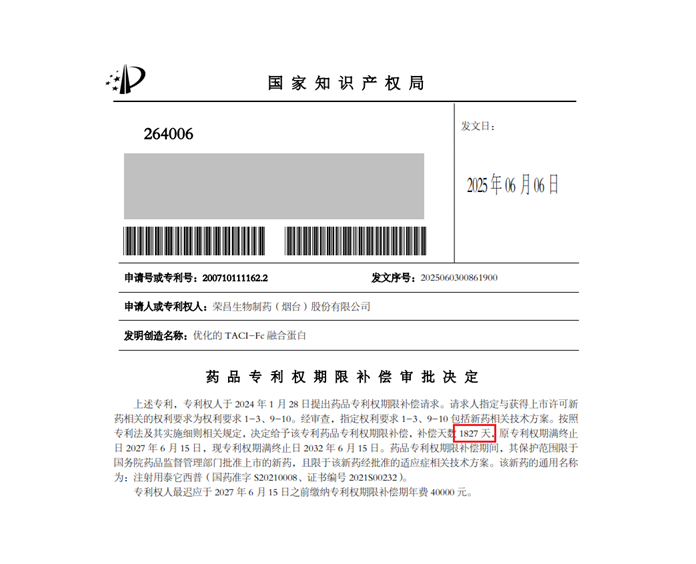
In June 2025, the China National Intellectual Property Administration (CNIPA) granted a patent term extension of 1,827 days (approximately five years) for the core patent (ZL200710111162.2) of Telitacicept (brand name: Tai’ai), an injectable drug developed by RemeGen. This extends the original expiration date from June 15, 2027, to June 15, 2032. This is the first pharmaceutical patent case in the pharmaceutical sector to receive the maximum extension under the new Patent Law—a so-called “top extension.”
What is Telitacicept?
Telitacicept is the world’s first dual-target TACI-Fc fusion protein that simultaneously targets BLyS (B cell activating factor) and APRIL (a proliferation-inducing ligand). By binding to both BLyS and APRIL, it suppresses abnormal B cell activity through a complex mechanism. This has shown groundbreaking effectiveness in treating various autoimmune diseases.
- Initial Approved Indication: In March 2021, the drug was approved by China’s National Medical Products Administration (NMPA) for the treatment of moderate to severe systemic lupus erythematosus (SLE).
- Subsequent Indications: In July 2024, it was approved for rheumatoid arthritis (RA), and in May 2025, for generalized myasthenia gravis (gMG).
- Clinical Results for gMG: At the 2025 Annual Meeting of the American Academy of Neurology (AAN), clinical trial results showed that after 24 weeks:
- 98.1% of patients experienced a ≥3-point improvement on the MG-ADL scale
- 87% of patients had a ≥5-point improvement on the QMG scale
These results indicate exceptionally high therapeutic efficacy.
- Significance of the Pharmaceutical Patent Term Compensation System in China
- Institutional Significance
Pharmaceutical development requires an exceptionally long period—from basic research through clinical trials to regulatory approval. It can take over 10 years to develop a new drug, during which the patent term continues to run. As a result, by the time the drug finally reaches the market, much of its patent life may have already expired, significantly reducing the originally anticipated period of market exclusivity.
In such cases, despite substantial investments in research and development, companies may not be able to fully recoup their costs through exclusive rights, potentially weakening incentives for new drug innovation. The patent term compensation system was introduced to address this issue. It allows for a partial extension of the patent term to compensate for the time spent on development and regulatory review.
This helps restore a portion of the lost exclusivity period, even if little time remains on the original patent, and delays the market entry of generics for a limited period. As a result, it improves the prospects for profitability despite the risks and costs of drug development and supports more stable returns on investment—ultimately motivating pharmaceutical companies to continue pursuing new drug research and innovation.
- Comparison with Other Countries
Patent term compensation systems have already been adopted and are in operation in jurisdictions such as the United States (under the Hatch-Waxman Act), Japan, South Korea, the EU, and Canada. Notably, both China and the U.S. set similar upper limits for compensation—up to five years in duration, with a maximum of 14 years of exclusivity after market approval. In the EU, the compensation period can also be extended by up to five years, but the maximum post-approval exclusivity can reach 15 years.
- Significance of the 1,827-Day Compensation for Telitacicept
The 1,827-day extension corresponds to the effective upper limit (approximately five years) allowed under China’s revised Patent Law. This milestone carries several important implications:
- Example of Maximum Compensation for Market Approval Delays
Although Telitacicept was approved by the National Medical Products Administration (NMPA) in March 2021, the long development timeline significantly eroded its effective patent life. In response, the maximum allowable patent term compensation under the current system was applied. This not only underscores the drug’s high level of innovation and development complexity, but also serves as a textbook example demonstrating that full-term compensation can indeed be essential under the revised system.
- Establishment of a Precedent in the Industry
To date, few examples of patent term compensation have been granted in China, and none had previously reached the system’s upper limit. For instance, a prior case awarded a 140-day extension for Penpulimab, an immune checkpoint inhibitor jointly developed by Chia Tai Tianqing and AkesoBio. That case represented a partial application of the system. In contrast, the full five-year extension granted to Telitacicept marks a groundbreaking first. It sets both a practical and institutional precedent for the implementation of China’s pharmaceutical patent compensation system. This landmark case provides a clear and valuable roadmap for other companies developing innovative drugs to make full use of the system.
- Boosting Business Performance Through Enhanced IP Protection
Telitacicept achieved annual sales of approximately 977 million yuan in 2024 (around ¥19.5 billion at an exchange rate of 1 yuan ≈ 20 yen), reflecting a 94.9% year-over-year growth from 2023. The effective extension of market exclusivity via this patent compensation is expected to further support revenue stability, with cumulative sales over the next five years potentially reaching 10 billion yuan (around ¥200 billion). This is drawing significant attention as a real-world example of how robust intellectual property protection can directly enhance a company’s competitiveness and profitability.
- Merits and Concerns of China’s Pharmaceutical Patent Term Compensation System
Merits:
- Extended Market Exclusivity Directly Boosts Corporate Revenue
The introduction of the patent term compensation system allows companies to delay the entry of generics into the market, securing sufficient profits before price competition kicks in. For blockbuster drugs in particular, even a one-year extension of patent protection can translate into hundreds of millions of yen in additional revenue.
- Assurance of R&D Investment Recovery
Since the development of new drugs can take more than a decade and involve substantial costs, the compensation system offers institutional support for ensuring a return on investment. For startups and small-to-mid-sized enterprises, the existence of this system can also positively influence their business valuations.
- Stronger Position in International Negotiations
Proven implementation of the patent compensation system in countries like China, Japan, the EU, and the U.S. enhances leverage in global licensing negotiations and joint development contracts. The extended exclusivity period guaranteed by compensation adds certainty to revenue projections and can serve as a strategic asset in royalty negotiations.
Concerns:
- Potential for Higher Domestic Drug Prices
Extending the patent protection period delays the market entry of generics, potentially postponing cost-saving effects for healthcare systems. This could, in turn, impact national health insurance finances and increase out-of-pocket expenses for patients—an important social consequence that should not be overlooked.
- Fairness in the Innovation System
Patent compensation applies only to specific types of patents as defined by law—such as compound patents, manufacturing process patents, and use patents—and is not available for all pharmaceutical development projects. As a result, there is a potential disparity between companies that can benefit from this system and those that cannot. Ensuring fairness in protecting innovation, and addressing this structural imbalance, remains an important policy challenge.
- Balancing Patient Burden
As the compensation system becomes further institutionalized and expanded, a critical policy issue will be how to balance drug pricing levels during extended periods of market exclusivity with their potential impact on healthcare budgets and patients’ out-of-pocket expenses. Striking a workable balance between safeguarding corporate profits through patent compensation and maintaining compatibility with national healthcare and social security systems will be essential going forward.
- Implications for Overseas Intellectual Property Professionals
The recent case in which China granted the maximum allowable patent term compensation provides several important insights for foreign companies. However, China’s patent term compensation system fundamentally requires that China be the first country in the world to approve the drug, which makes it generally difficult for foreign companies to benefit from the system as it stands. That design prompts overseas stakeholders to reconsider their strategies from two major perspectives:
Reframing China as a “Priority Market for Early Regulatory Approval”
Traditionally, Japanese and multinational pharmaceutical companies have pursued approval in China only after securing it in major markets such as the U.S., Europe, and Japan. However, this latest development highlights the increasing strategic value of designating China as a primary target country for early or even simultaneous drug submissions. Doing so would allow companies to maximize market exclusivity in China through eligibility for patent term compensation.
For example, Japanese drug developers could consider submitting applications in China alongside or even ahead of Japan, by building parallel development pathways or establishing a domestic clinical trial infrastructure within China.
Developing an “IP Strategy Tailored to Local Regulatory Frameworks”
China’s pharmaceutical patent compensation system—specifically its criteria for qualifying patents and strict application timelines—differs from those of Japan and the U.S. Therefore, it is crucial for companies to:
- Identify core patents likely to qualify for compensation under Chinese law
- Secure solid patent rights domestically in China
- Establish robust procedural coordination with CNIPA and NMPA in line with their interagency referral system
These steps will ensure that a company’s IP strategy is aligned with local rules and maximizes the potential benefits of the system.
- Conclusion
China’s pharmaceutical patent term compensation system, developed as part of the new Patent Law framework, represents an innovative structure aligned with global standards seen in countries like Japan and the United States. The 1,827-day extension granted to RemeGen’s Telitacicept serves as a real-world “success model,” demonstrating the system’s practical effectiveness rather than remaining a theoretical concept. This case provides a significant benchmark for both domestic and international pharmaceutical companies.
Although the Chinese system isn’t readily accessible to foreign firms due to its structural requirement—that China be the first country to approve the drug—it offers valuable strategic insights, especially regarding the optimization of approval sequencing and restructuring of local IP strategies.
Going forward, companies should consider repositioning China not merely as a sales market but as a strategic base for development and regulatory filing. This shift could create new competitive advantages in the increasingly globalized pharmaceutical landscape.
References
- RemeGen Product Overview – Telitacicept
- Official Website: Provides detailed product information, including Telitacicept’s mechanism of action, indications, and development pipeline.
- NMPA Disclosure Database: Offers regulatory filings and approval status from China’s National Medical Products Administration (NMPA).
- AAN Conference Presentation – Clinical Efficacy in Myasthenia Gravis
- American Academy of Neurology Abstract #61469: Summarizes Phase 3 trial results showing that Telitacicept achieved a ≥3-point improvement in MG-ADL in 98.1% of patients and a ≥5-point improvement in QMG in 87.0% of patients after 24 weeks of treatment.