
China’s First “5-Year Extension” Case Under the Patent Term Compensation System

  1. Background and System Overview

The new Patent Law of the People’s Republic of China, which came into effect on June 1, 2021, introduced a pharmaceutical patent term compensation system (commonly referred to as a patent term extension system) under Article 42, Paragraph 3. This system is designed to offset delays in regulatory approval for new drug launches. The maximum compensation period is five years, with the effective patent term after market approval capped at 14 years. This revision aims to address the shortening of market exclusivity periods, taking into account that the development and approval of new drugs now takes more than 10 years on average.

  1. “Top Extension” for the New Drug Telitacicept

Summary of Extension Decision

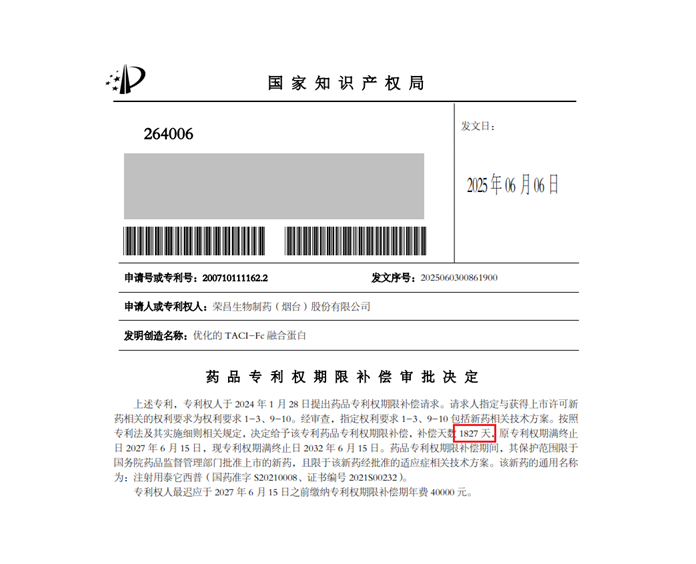
In June 2025, the China National Intellectual Property Administration (CNIPA) granted a patent term extension of 1,827 days (approximately five years) for the core patent (ZL200710111162.2) of Telitacicept (brand name: Tai’ai), an injectable drug developed by RemeGen. This extends the original expiration date from June 15, 2027, to June 15, 2032. This is the first pharmaceutical  patent case in the pharmaceutical sector to receive the maximum extension under the new Patent Law—a so-called “top extension.”
What is Telitacicept?

Telitacicept is the world’s first dual-target TACI-Fc fusion protein that simultaneously targets BLyS (B cell activating factor) and APRIL (a proliferation-inducing ligand). By binding to both BLyS and APRIL, it suppresses abnormal B cell activity through a complex mechanism. This has shown groundbreaking effectiveness in treating various autoimmune diseases.

  • Initial Approved Indication: In March 2021, the drug was approved by China’s National Medical Products Administration (NMPA) for the treatment of moderate to severe systemic lupus erythematosus (SLE).
  • Subsequent Indications: In July 2024, it was approved for rheumatoid arthritis (RA), and in May 2025, for generalized myasthenia gravis (gMG).
  • Clinical Results for gMG: At the 2025 Annual Meeting of the American Academy of Neurology (AAN), clinical trial results showed that after 24 weeks:
    • 98.1% of patients experienced a ≥3-point improvement on the MG-ADL scale
    • 87% of patients had a ≥5-point improvement on the QMG scale

These results indicate exceptionally high therapeutic efficacy.


  1. Significance of the Pharmaceutical Patent Term Compensation System in China
  • Institutional Significance

Pharmaceutical development requires an exceptionally long period—from basic research through clinical trials to regulatory approval. It can take over 10 years to develop a new drug, during which the patent term continues to run. As a result, by the time the drug finally reaches the market, much of its patent life may have already expired, significantly reducing the originally anticipated period of market exclusivity.

In such cases, despite substantial investments in research and development, companies may not be able to fully recoup their costs through exclusive rights, potentially weakening incentives for new drug innovation. The patent term compensation system was introduced to address this issue. It allows for a partial extension of the patent term to compensate for the time spent on development and regulatory review.

This helps restore a portion of the lost exclusivity period, even if little time remains on the original patent, and delays the market entry of generics for a limited period. As a result, it improves the prospects for profitability despite the risks and costs of drug development and supports more stable returns on investment—ultimately motivating pharmaceutical companies to continue pursuing new drug research and innovation.


  • Comparison with Other Countries

Patent term compensation systems have already been adopted and are in operation in jurisdictions such as the United States (under the Hatch-Waxman Act), Japan, South Korea, the EU, and Canada. Notably, both China and the U.S. set similar upper limits for compensation—up to five years in duration, with a maximum of 14 years of exclusivity after market approval. In the EU, the compensation period can also be extended by up to five years, but the maximum post-approval exclusivity can reach 15 years.

  1. Significance of the 1,827-Day Compensation for Telitacicept

The 1,827-day extension corresponds to the effective upper limit (approximately five years) allowed under China’s revised Patent Law. This milestone carries several important implications:

  • Example of Maximum Compensation for Market Approval Delays

Although Telitacicept was approved by the National Medical Products Administration (NMPA) in March 2021, the long development timeline significantly eroded its effective patent life. In response, the maximum allowable patent term compensation under the current system was applied. This not only underscores the drug’s high level of innovation and development complexity, but also serves as a textbook example demonstrating that full-term compensation can indeed be essential under the revised system.

  • Establishment of a Precedent in the Industry

To date, few examples of patent term compensation have been granted in China, and none had previously reached the system’s upper limit. For instance, a prior case awarded a 140-day extension for Penpulimab, an immune checkpoint inhibitor jointly developed by Chia Tai Tianqing and AkesoBio. That case represented a partial application of the system. In contrast, the full five-year extension granted to Telitacicept marks a groundbreaking first. It sets both a practical and institutional precedent for the implementation of China’s pharmaceutical patent compensation system. This landmark case provides a clear and valuable roadmap for other companies developing innovative drugs to make full use of the system.

  • Boosting Business Performance Through Enhanced IP Protection

Telitacicept achieved annual sales of approximately 977 million yuan in 2024 (around ¥19.5 billion at an exchange rate of 1 yuan ≈ 20 yen), reflecting a 94.9% year-over-year growth from 2023. The effective extension of market exclusivity via this patent compensation is expected to further support revenue stability, with cumulative sales over the next five years potentially reaching 10 billion yuan (around ¥200 billion). This is drawing significant attention as a real-world example of how robust intellectual property protection can directly enhance a company’s competitiveness and profitability.

  1. Merits and Concerns of China’s Pharmaceutical Patent Term Compensation System

Merits:

  • Extended Market Exclusivity Directly Boosts Corporate Revenue

The introduction of the patent term compensation system allows companies to delay the entry of generics into the market, securing sufficient profits before price competition kicks in. For blockbuster drugs in particular, even a one-year extension of patent protection can translate into hundreds of millions of yen in additional revenue.

  • Assurance of R&D Investment Recovery

Since the development of new drugs can take more than a decade and involve substantial costs, the compensation system offers institutional support for ensuring a return on investment. For startups and small-to-mid-sized enterprises, the existence of this system can also positively influence their business valuations.

  • Stronger Position in International Negotiations

Proven implementation of the patent compensation system in countries like China, Japan, the EU, and the U.S. enhances leverage in global licensing negotiations and joint development contracts. The extended exclusivity period guaranteed by compensation adds certainty to revenue projections and can serve as a strategic asset in royalty negotiations.

Concerns:

  • Potential for Higher Domestic Drug Prices

Extending the patent protection period delays the market entry of generics, potentially postponing cost-saving effects for healthcare systems. This could, in turn, impact national health insurance finances and increase out-of-pocket expenses for patients—an important social consequence that should not be overlooked.

  • Fairness in the Innovation System

Patent compensation applies only to specific types of patents as defined by law—such as compound patents, manufacturing process patents, and use patents—and is not available for all pharmaceutical development projects. As a result, there is a potential disparity between companies that can benefit from this system and those that cannot. Ensuring fairness in protecting innovation, and addressing this structural imbalance, remains an important policy challenge.

  • Balancing Patient Burden

As the compensation system becomes further institutionalized and expanded, a critical policy issue will be how to balance drug pricing levels during extended periods of market exclusivity with their potential impact on healthcare budgets and patients’ out-of-pocket expenses. Striking a workable balance between safeguarding corporate profits through patent compensation and maintaining compatibility with national healthcare and social security systems will be essential going forward.

  1. Implications for Overseas Intellectual Property Professionals

The recent case in which China granted the maximum allowable patent term compensation provides several important insights for foreign companies. However, China’s patent term compensation system fundamentally requires that China be the first country in the world to approve the drug, which makes it generally difficult for foreign companies to benefit from the system as it stands. That design prompts overseas stakeholders to reconsider their strategies from two major perspectives:

Reframing China as a “Priority Market for Early Regulatory Approval”

Traditionally, Japanese and multinational pharmaceutical companies have pursued approval in China only after securing it in major markets such as the U.S., Europe, and Japan. However, this latest development highlights the increasing strategic value of designating China as a primary target country for early or even simultaneous drug submissions. Doing so would allow companies to maximize market exclusivity in China through eligibility for patent term compensation.

For example, Japanese drug developers could consider submitting applications in China alongside or even ahead of Japan, by building parallel development pathways or establishing a domestic clinical trial infrastructure within China.

Developing an “IP Strategy Tailored to Local Regulatory Frameworks”

China’s pharmaceutical patent compensation system—specifically its criteria for qualifying patents and strict application timelines—differs from those of Japan and the U.S. Therefore, it is crucial for companies to:

  • Identify core patents likely to qualify for compensation under Chinese law
  • Secure solid patent rights domestically in China
  • Establish robust procedural coordination with CNIPA and NMPA in line with their interagency referral system

These steps will ensure that a company’s IP strategy is aligned with local rules and maximizes the potential benefits of the system.

  1. Conclusion

China’s pharmaceutical patent term compensation system, developed as part of the new Patent Law framework, represents an innovative structure aligned with global standards seen in countries like Japan and the United States. The 1,827-day extension granted to RemeGen’s Telitacicept serves as a real-world “success model,” demonstrating the system’s practical effectiveness rather than remaining a theoretical concept. This case provides a significant benchmark for both domestic and international pharmaceutical companies.

Although the Chinese system isn’t readily accessible to foreign firms due to its structural requirement—that China be the first country to approve the drug—it offers valuable strategic insights, especially regarding the optimization of approval sequencing and restructuring of local IP strategies.

Going forward, companies should consider repositioning China not merely as a sales market but as a strategic base for development and regulatory filing. This shift could create new competitive advantages in the increasingly globalized pharmaceutical landscape.

References

  1. RemeGen Product Overview – Telitacicept
    • Official Website: Provides detailed product information, including Telitacicept’s mechanism of action, indications, and development pipeline.
    • NMPA Disclosure Database: Offers regulatory filings and approval status from China’s National Medical Products Administration (NMPA).
  2. AAN Conference Presentation – Clinical Efficacy in Myasthenia Gravis
    • American Academy of Neurology Abstract #61469: Summarizes Phase 3 trial results showing that Telitacicept achieved a ≥3-point improvement in MG-ADL in 98.1% of patients and a ≥5-point improvement in QMG in 87.0% of patients after 24 weeks of treatment.

Summary of Measures on Administrative Adjudication and Mediation of Patent Disputes in China

I. Overview

The “Measures on Administrative Adjudication and Mediation of Patent Disputes” (hereinafter referred to as “Measures”) came into effect on February 1, 2025. The “Measures” are composed of five parts: General Provisions, Administrative Adjudication, Administrative Mediation, Legal Liability, and Supplementary Provisions, and are consistent with the China Patent Law (2020 Revised Law) and the Patent Law Administrative Regulations (2023 Revised Regulations ), as well as the previously unorganized “Measures on Patent Administration Enforcement”, “Measures on Administrative Adjudication of Major Patent Infringement Disputes”, “Measures on Administrative Adjudication of Pharmaceutical Patent Disputes”. In order to further clarify the standards and procedures for resolving patent disputes through administrative means, and to solve the new problems that have emerged in patent practice, such as pharmaceutical patent disputes and open licensing disputes, China will strengthen intellectual property protection and bring it in line with international standards. China is strengthening its intellectual property protection and bringing it in line with international standards.

China adopts the “dual track system” in which civil litigation (judicial route) and administrative adjudication (administrative route) are used in parallel as means of resolving infringement disputes, and it is characteristic that the parties can freely choose the route according to their purposes by comparing the advantages and disadvantages of each route. Compared to the judicial route, the administrative route is widely used for its advantages such as high efficiency, low cost, professionalism, and simplicity of procedures. In this article, we will discuss the main contents of the “Measures” and interpret some of the key provisions to examine how companies can use the system to better protect their rights and avoid abuse of patent rights by malicious intent.


II. Major Provisions of the “Measures”

(1) Introduction of new system

  1. Reflecting the amended Patent Law

Establishes administrative adjudication of serious patent infringement disputes (Articles 55-58)

Establishment of administrative adjudication of early resolution mechanism for pharmaceutical patent disputes (Articles 59-62)

Establishes administrative arbitration of patent licensing disputes (Articles 76-79)

Adds provisions on informatization construction and data management (Article 11).

Clarified the time limit for requesting adjudication (Article 19).

  1. Reflecting the amended Patent Law Implementation Regulations

Clarified the detailed regulations on administrative jurisdiction (Articles 6 -9)

Added provisions on electronic service of process (Article 10).

Improved standards for arbitration of employee inventions (Article 74).

  1. extraction of beneficial methods in practice

Extracting beneficial methods from the practice of administrative adjudication of major infringement disputes and early resolution mechanism of pharmaceutical patent disputes and introducing relevant provisions in the “Measures” (Articles 55-62).


(2) Improvement of norms on substantive procedures

  1. response to the requests of the case-handling body and parties

Added provisions on the addition of related parties (Articles 23-24)

Clarification of relevant requirements for oral hearings (Articles 26-27)

Introduction of technical investigation and technical expert opinion (Articles 52-53)

  1. Clarified the criteria for determining patent infringement

Clarified the scope of patent protection, the all-element principle, the estoppel principle, the dedication principle, and the same and equal infringement (Articles 38-42).

  1. further improvement of other norms

Improvements to the provisions on jurisdiction and the method of conclusion (Articles 6 to 9, Article 30).

Clarification of the specific circumstances for case discontinuance (Article 28)

Added provisions on handling of failure to decide and repeated infringement (Article 34).


(3) Optimization of procedures

  1. simplification of documents and procedures

Simplification of requirements for documents to be submitted by the parties (Articles 18 and 46)

  1. Optimization of procedures for acceptance, establishment of a case, investigation, and submission of evidence

Clarify requirements for making a case (Article 20)

Improve rules for allocation of burden of proof (Article 45)

  1. Improvement of measures related to avoidance, confidentiality and handling of entrusted cases

Specific rules for avoidance (Article 5)

Added provisions on handling of entrusted cases (Article 8).

Clarification of confidentiality responsibilities of parties (Article 82)


III. Explanation of Relevant Provisions

(1) Adoption of the collegial system (Articles 20 and 25)

The “Measures” clarifies that a collegial system shall be adopted in the handling of administrative adjudication cases. Article 20 of the “Measures” stipulates that when issuing a notice of case to a claimant, the enforcement department shall appoint three or more (odd number) persons to form a council to handle the patent infringement dispute at the same time. The council may decide to postpone the defense (Article 22 of the “Measures” ), conduct an oral hearing (Article 26 of the “Measures” ), conduct an online oral hearing (Article 27 of the “Measures” ), and conduct a technical opinion (Article 53 of the “Measures” ), among other matters.

In addition, Article 25 of the “Measures” stipulates that the collegial body shall fully deliberate on the findings of fact, the admissibility of evidence, legal responsibility, the application of law, and the results of the process, and render a decision by majority vote. The deliberation record must record the process and results of deliberation based on the facts, including the majority and dissenting opinions.


(2) Overseas Identification and Overseas Evidence (Articles 18 and 46)

The “Measures” improve the provisions on valid identity proof for foreigners, clarifying that “for foreigners who have obtained permanent residence status in China, their permanent residence certificate shall be valid identity proof. Based on the “Convention on the Non-Necessity of Authentication of Foreign Official Documents,” the “Measures” stipulate that “if there are special provisions for certification procedures in relevant treaties concluded by the People’s Republic of China, they shall be followed” to ensure fairness and efficiency in administrative adjudication and arbitration.


(3) Jurisdiction (Articles 6 and 9)

Article 6 states that patent infringement disputes shall be under the jurisdiction of the patent administration department of the place where the infringement occurred or the place of residence of the accused. If the administrative adjudication is requested in the place of residence of the respondent, it may not always be possible to avoid the local protection principle, etc. Therefore, overseas right holders may take advantage of the provision of Article 12 that the claimant is the patentee or interested party, and request adjudication through the interested party in the place of occurrence of the infringement. If there is an objection to jurisdiction, it is possible to file an objection within the reply period in accordance with Article 9 of the “Measures”. Within five days of receipt of the objection, the patent administration department must decide whether the case needs to be transferred or not.


(4) Standard Essential Patents (Article 30)

Standard essential patents are the focus of current market competition and an important means of improving industrial competitiveness. In the process of soliciting opinions, the “Measures” have attracted widespread attention and controversy regarding the application of standard essential patents. Although standard essential patents are still patents in nature and should not be excluded from the scope of application of the “Measures”, they are certainly unique and complex. Therefore, in the adjudication and arbitration of standard essential patents, it is stipulated to refer to the provisions on standard essential patents in relevant laws, regulations, and judicial interpretations (e.g., “Provisions on the Prohibition of Abusive Competition and Restrictions on Intellectual Property Rights”, “Antitrust Guidelines on Standard Essential Patents,” etc.).


(5) Provisional term of protection for divisional applications (Article 75)

The “Measures” stipulate that the publication date of a divisional application shall be based on the earlier publication date of the parent application and the divisional application. By bringing forward the starting point of the provisional term of protection of the divisional application, “providing protection in advance” is given to the scope of protection not covered by the parent application, and the right holder’s interests can be better protected.


(6) Time Limit Provisions (Articles 37 and 70)

The “Measures” stipulate that patent infringement disputes shall be closed within three months from the date of filing and may be extended within one month with the approval of the director of the patent administration department, depending on the complexity of the case. If the case is particularly complicated, it may be extended for up to two months. In the case of patent ownership dispute mediation, the case will be concluded within two months, and the case may be extended for up to one month with the approval of the director of the patent administration department, depending on the complexity of the case. Thus, the law clarifies that the administrative route has a shorter processing time than the judicial route, which ensures speed and efficiency.


(7) Response to warning letters (Article 13)

Article 13 of the “Measures” allows an enterprise that receives a warning letter of patent infringement to take countermeasures against the warning letter by sending a written request for an administrative ruling or a lawsuit to the warner, or by sending a written opinion of non-infringement to the warner. If the alerting party does not withdraw the warning or take legal measures within one month after receiving the written demand or written opinion, the alerted enterprise may request the administrative authority for an opinion on whether or not the infringement has been committed. This provision can effectively prevent the patentee from abusing the right of warning and ensure that the patent right is exercised reasonably.


(8) Administrative adjudication of major patent infringement disputes (Articles 55-58) and administrative adjudication for early resolution mechanism for pharmaceutical patent dispute (Articles 59-62)

In accordance with the 2020 Amendment to the Patent Law, Article 70, Paragraph 1 and Article 76, Paragraph 2 of the Patent Law, this “Measures” adds Section 4: Administrative Adjudication of Serious Patent Infringement Disputes and Section 5: Administrative Adjudication for early resolution mechanism for pharmaceutical patent dispute. In the draft of the Law, the Supplementary Provisions stated that the “Measures on Administrative Adjudication of Major Patent Infringement Disputes” and “Measures on Administrative Adjudication for early resolution mechanism for pharmaceutical patent dispute” would be abolished with the enforcement of the Law, but this was deleted in the Law which officially came into effect. However, the new version of the “Measures” has been deleted.


(9) Transitional Measures

The current Rules of the Department, “Measures for Patent Administrative Enforcement” (Bureau Order No. 71), has established relevant provisions for patent administrative adjudication and mediation in Chapter 2 “Patent Infringement Dispute Resolution” and Chapter 3 “Mediation of Patent Disputes”. In accordance with the principle that the new rules take precedence over the old rules, this “Measures” shall be applied to the relevant contents where the two rules are not in line with each other.


IV. Conclusion

The State Intellectual Property Office (CNIPA) has the highest level of examiners and experts in China, and its expertise is much higher than that of the courts, which means that the administrative decisions made by the CNIPA are very reliable. However, most administrative decisions in China are made by local government intellectual property bureaus, which vary in knowledge and expertise, and the standards for adjudication are not always stable.

Therefore, the implementation of the “Measures” is expected to play an important role in unifying the standards for adjudication and strengthening the position of the administrative route in parallel with the judicial route. It is necessary to keep a close eye on the implementation of this Law.


Source

(1).国家知识产权局 政策解读 《专利纠纷行政裁决和调解办法》解读

USPTO to begin issuing certificates of correction electronically beginning on January 30, 2024

Beginning on January 30, 2024, the USPTO will start issuing certificates of correction in a paperless, electronic format. The electronically issued certificates of correction will be immediately available to view online using the USPTO Patent Center upon the issuance of the patent itself. Electronic certificates of correction will be issued regardless of whether the patent has already issued electronically, or in paper format.

Until January 30, 2024, certificates of correction will continue to be issued in paper format and mailed via post to the correspondence address on record for the patent. After the paper certificate of correction is issued, a scanned image of the paper certificate of correction is entered into the file wrapper and added to the image of the patent in the patent database. Additionally, the patent number corresponding to the certificate of correction is published in the Official Gazette.

If you have any questions regarding certificates of correction, please do not hesitate to contact our office.

USPTO: Notice of upcoming DOCX filing fee date of January 17, 2024

The USPTO recently announced its intention to move forward with the implementation of the $400 USD fee for filing specifications and claims in non-DOCX format on January 17, 2024. While it may be possible that the USPTO will extend the deadline again, it appears more likely than not that the USPTO will not extend this deadline any further.

This filing fee applies to all non-provisional applications and continuing applications, but it is important to note that this fee does not apply to drawings, national stage applications, design applications, and provisional applications, which can still be filed in PDF format without incurring the surcharge.

If your organization has not made a decision about whether or not to transition to filing in the DOCX format, we encourage you to make a decision soon in order to prepare for the implementation of the non-DOCX filing fee.

If you have any questions or require more information, please do not hesitate to contact our office.